Convent girls’ forced confinement and labor
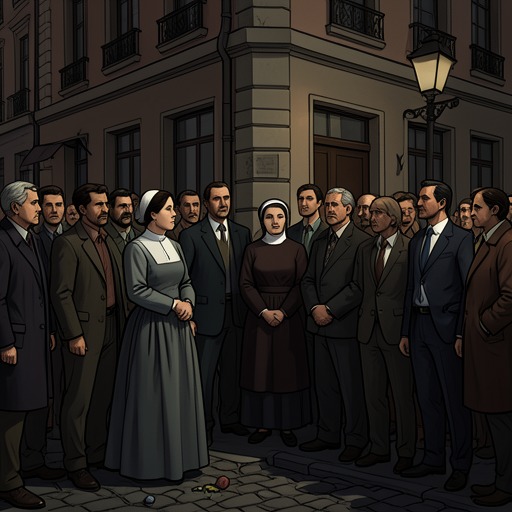
Small Things Like TheseConvent girls’ forced confinement and labor is the hidden reality beneath the convent’s reputation for discipline, education, and immaculate laundry. In New Ross, the institution’s polished public face coexists with young women’s exhausting work, restricted movement, and separation from family and children. Bill Furlong’s encounters expose not only the girls’ conditions but also the social habits that help keep them concealed: uncertainty, deference to authority, and the impulse to treat their suffering as someone else’s concern.
The Convent’s Public Face and Its Labor
The Good Shepherd Sisters ran a training school that provided girls with a basic education, as well as a laundry business whose customers included restaurants, guesthouses, the nursing home, the hospital, priests, and well-off households. Its work was praised for returning linen in almost-new condition. That reputation made the laundry’s output familiar throughout the town, while the lives of the girls doing the work remained obscure. The institution was visible on the hill beyond the River Barrow, but knowledge of its internal arrangements was fragmented and uncertain.
Town talk offered competing accounts. Some people described the girls as being reformed through penance and forced to wash stains from dirty linen from dawn until night. A local nurse was said to have treated a fifteen-year-old girl with varicose veins caused by standing for so long at the wash-tubs. Other stories instead portrayed the nuns as overworked, poorly fed, and forbidden to speak except in prayer. Still others claimed that unmarried girls were hidden away after giving birth and that their babies were adopted by wealthy Americans or sent to Australia for money. These accounts are reported as rumor, not as a settled explanation of every practice; the townspeople themselves acknowledged that much gossip could not be trusted. The uncertainty, however, also left the institution’s operations difficult to challenge.
What Furlong Sees Inside
Furlong’s direct observations make the girls’ labor more than a matter of hearsay. On an earlier visit, after entering through a heavy door near the coal house, he found more than a dozen young women and girls in a small, lighted chapel. They were on their hands and knees, using rags and tins of lavender polish to work in circles across the floor. They wore no shoes, only black socks and grey shifts. One had a stye; another’s hair had been cut roughly, as if with shears. Their appearance and work sharply contradicted the convent’s neat, almost Christmas-card image from the town.
Later, before dawn, Furlong opened the coal-house door and discovered a girl inside. Frost had stiffened the bolt; he needed a torch to see into the darkness. What lay on the floor suggested to him that she had been confined there longer than a single night. When he tried to cover her with his overcoat, she cowered. The episode makes the institution’s control concrete: confinement was not only a general condition inferred from rumors, but an immediate physical restriction imposed on a girl in an outbuilding.
The contrast between the convent’s front and rear makes that restriction visible in the setting as well. Its manicured lawns, orderly shrubs, holly, and shining windows presented a carefully maintained face toward New Ross. When Furlong later circled its back in the snow, he found high walls topped with broken glass and third-storey windows blackened and fitted with metal grilles. The exterior does not by itself explain what happened inside, but it gives physical form to the separation between the convent and the community that relied on its laundry.
Separation, Silence, and Social Complicity
The girl’s confinement is bound up with a more personal loss: she tells Furlong that her fourteen-week-old baby has been taken from her. She does not know where the child is and asks him to find out whether she may feed him again. Her concern is immediate and practical—she fears that the baby must be hungry and wonders who is caring for him. The reported stories of adoption and concealment thus acquire a human consequence in the scene: a mother is kept from her infant while lacking even basic information about his whereabouts.
Furlong initially considers avoiding the matter. At home, Eileen Furlong tells him that the convent’s affairs have nothing to do with them, points to the nuns’ timely payments, and reminds him that the girls need warmth like anyone else. She argues that people must ignore certain things if they want to get on in life, and observes that he was raised far from hardship. Her response shows how everyday economic dependence and social caution can turn awareness into a reason for inaction. The convent’s patrons benefit from clean laundry; its payments and reputation give practical force to the argument that intervention would be unwelcome or costly.
When Furlong returns the girl to the convent, the Mother Superior receives him with courtesy, apologizes for his having encountered the girl, and says that the staff had noticed her missing and were about to call the Gardaí. She describes the girl as sometimes unable to tell night from day and says that she does not know how they will care for her. The girl’s confinement in the shed is therefore met not with a clear account of responsibility but with language that presents her as difficult to manage. The Mother Superior also remarks that there are many girls nowadays and that finding a place for everyone is not easy. Her comments place the individual girl within a larger institutional population while leaving the conditions producing their vulnerability unaddressed.
From Witness to Practical Care
The separation between the girl and her baby remains unresolved when Furlong brings her back. After waiting with her outside, he hears her ask him to ask about the child; she says she does not know where he is and hopes she may be allowed to feed him. At the convent, the Mother Superior sends the girl upstairs for a hot bath. Later, in the kitchen, a young nun is preparing food while the girl sits dazed at the table with nothing in front of her. Furlong is expected to leave, and he has accepted an envelope from the Mother Superior for Christmas, but he pauses beside the girl and offers to help if she will tell him what she needs. She looks toward the window, takes a breath, and begins to cry, a response the narrative links to the unfamiliarity of kindness.
Furlong does not remain a detached observer. After reflecting on the girl’s plight, he returns to the convent at night and goes around its enclosed rear, past the glass-topped walls and barred windows, before reaching the coal-house door. He hesitates, calls to the girl, and gives his name. This time she takes his coat and leans on him as he leads her out. The change is small in physical scale—one door opened, one girl accompanied—but decisive in what it makes possible: he acts rather than leaving her inside.
As they walk away, Furlong asks himself whether life has meaning without helping others and whether a person can go through life without the courage to oppose what is wrong and still call himself a Christian. The question sets the convent’s treatment of the girls against the religious ideals of care and the promise that all children should be cherished equally. He thinks, too, of Mrs Wilson’s kindness to his own mother and recognizes that, without that help, his mother might have ended up in such a place. The girls’ confinement therefore exposes both a present failure of care and the precariousness of the protection on which Furlong’s own life depended.